Private tours in Lisbon & surroundings
|
|
|
|
|
Program Leave Lisbon and stop at Queluz palace. Time to visit the Portuguese Versailles: palace and gardens tell us about the “rocaille” style and the way of living in the XVIII century. Proceed to Pena Palace at the top of Sintra mountain. A XIX century palace with a mixture of several styles: Oriental, Arab, Indian, Neo-classic, Manueline, Renaissance… a fairy tale like palace with a stunning view over the ocean, mountain, Lisbon. And surrounded by a park with 1000 different species of plants. Driving through the twisted roads of Sintra mountain we arrive to Capuchos convent: the smallest convent in Portugal, dug in the granite rock of Sintra, where monks used to live in the XVI century. Next is -Mafra convent and palace: dating from the XVIII century, one of the biggest constructions in Europe, all made of marble, with 900 rooms and a 200 feet high dome. An impressive building telling about the wealth of king John V. Close by is “Portugal in miniature” or Franco house, with miniatures of houses and monuments of Portugal. Finally we arrive to Ericeira beach. Perched on cliffs overlooking the Atlantic, is a growing fishing village with a charming ambiance. Its pretty narrow streets with whitewashed chapels and white houses edged in blue are a joy to wander around or to a superb seafood meal at one of the many popular restaurants.
|
|
|
| |
|
|
|
Queluz National Palace is a Portuguese 18th-century palace is one of the last great Rococo buildings to be designed in Europe. The palace was conceived as a summer retreat for Dom Pedro of Braganza, later to become husband and then king consort to his own niece, Queen Maria I. It served as a discreet place of incarceration for Queen Maria as her descent into madness continued in the years following Dom Pedro's death in 1786. Queluz Palace became the official residence of the Portuguese prince regent, John VI, and his family and remained so until the Royal Family fled to Brazil in 1807 following the French invasion of Portugal. Work on the palace began in 1747. Despite being far smaller, the palace is often referred to as the Portuguese Versailles and today is open to the public as a major tourist attraction.
|
|
| |
Pena National Palace is the oldest palace inspired by European Romanticism. The palace stands on the top of a hill above the town of Sintra, and on a clear day it can be easily seen from Lisbon and much of its metropolitan area. It is a national monument and constitutes one of the major expressions of 19th century Romanticism in the world. The palace is a UNESCO World Heritage Site and one of the Seven Wonders of Portugal. King Ferdinand and Queen Maria II intervened decisively on matters of decoration and symbolism. Among others, the King suggested vault arches, Medieval and Islamic elements be included, and he also designed an exquisitely ornate window for the main façade The palace quickly drew visitors and became one of Portugal's most visited monuments. Over time the colors of the red and yellow façades have displayed such a chromatic variety.
|
|
|
| |
|
|
|
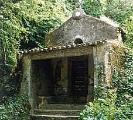
Convento dos Capuchos in Sintra is one of the most bizarre attractions the town has to offer. Located deep in the woods, the Convento is a hobbit-like building. The architect purposely designed the Convento dos Capuchos to have low ceilings, narrow doorways, and small spaces. The result is that visitors feel as if they've stepped into a magical world for tiny beings. This little monastery, constructed amid the rocks of Sintra in fulfilment of a vow by Dom Álvaro de Castro (1560), its cells and dependencies lined with cork, is a wonderful example of Christian austerity in its simplicity of decoration and meagre materials and space. The little chapel, the refectory, the living quarters, almost troglodyte in dimension, are cut into the crags, and underline the intention of meditation inherent in the project.
|
|
| |
Commonly called «Mafra Convent» includes the Palace, the Monastery, the Library and the Basilica. The building of the most opponent Portuguese Baroque monument began in 1717, under the supervision of the German architect Friedrich Ludwig. The works were concluded by 1730. The façade is about 660 ft long, with the Basilica in the middle and the Palace and the Monastery on each side. The marble came from the quarries of Pêro Pinheiro and Sintra, the wood from Brazil. From France, Belgium, Italy and Holland arrived the bells, the statues, the carillons, the silver table ware and the chandeliers. All this amounts to an enormous building with 880 rooms, 300 cells, 4500 doors and windows, 154 staircases and 29 courtyards. The Royal Palace was a summer residence, besides lodging the Court during the hunting season. An enormous corridor crosses the palace, giving access to all its rooms and chambers. The magnificent Library, kept by the friars, has about 36 thousand rare books!
|
|
|
| |
|
|
|
Ericeira is a fishing village 50 km (31 miles) northeast of Lisbon. It has has the Atlantic Ocean as an eternal companion. Out of this relationship, the sun has given the best of its light and an ocean of traditions has been born. The hospitality of its people, the harmony of the "old village" with its narrow cobblestone streets, characteristic housing, singular monuments, the sea, the fishing, the cuisine, the bold Atlantic views and the multiplicity of cultural programming interlace here in a grand way to welcome its visitors. Picturesquely located above the steep and rocky coast, full of clefts and caves, Ericeira, which has a long tradition as a little port and fishing village, has come increasingly to rely on earnings from tourism generated by the nearby beaches.
|
|
|
|